When it comes to hardship, USCIS must take the qualifying relative as they find them. That duty, however, can only be met when the qualifying relative’s full story has been told.
Every person has a story, a special story. The question is whether anyone is telling it in full. In I-601 waiver practice, too often the answer is no.
Lawyers submit forms. Clients summarize symptoms. Adjudicators check boxes. Too often, in that process, the qualifying relative, a human being shaped by everything which has ever happened to them, gets reduced to a checklist of hardship factors that fails to capture who they actually are.
That failure has a cost. A person’s backstory is not background noise. It is critical evidence — the context that gives everything else in the record its proper weight.
Without it, a qualifying relative’s hardship can appear ordinary to an adjudicator when, told in full, it is anything but. For this person, in this family, at this moment, the difference matters. When that story goes untold in full, meritorious cases lose. Not on the law, but on the telling.
This article is about doing both: telling the story better and more completely. Because when it comes to hardship, the starting point is ensuring that everyone — the lawyer, the client, and the adjudicator — takes the qualifying relative as they find them.
The Snapshot Problem: Why The Standard Hardship Presentation Falls Short
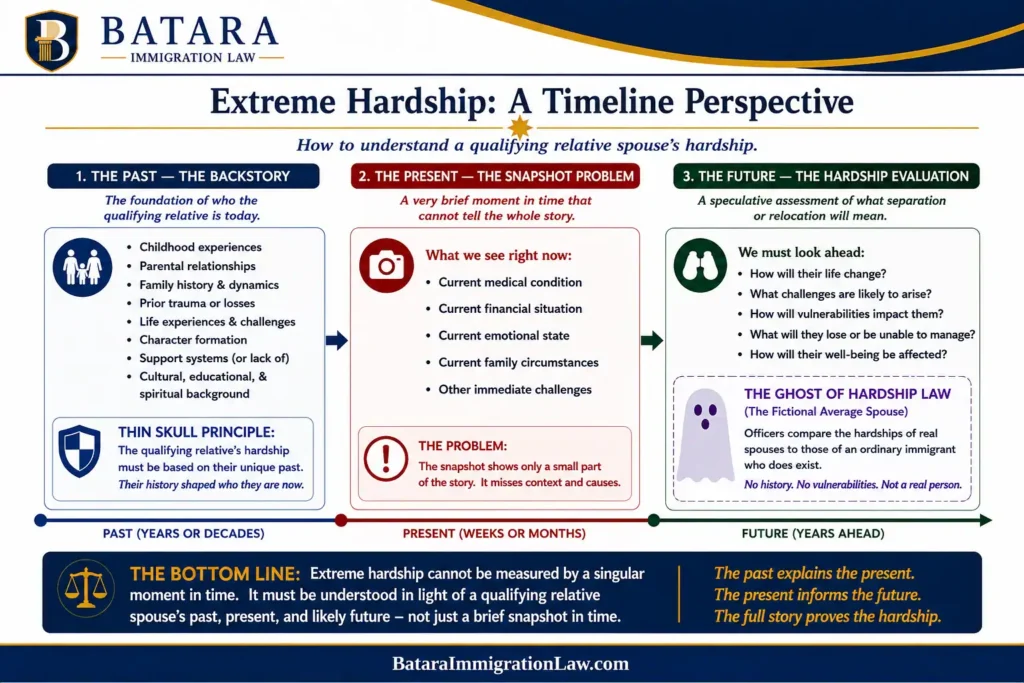
The depth of a person’s hardship upon separation of a spouse cannot be deduced from a mere snapshot of a family’s situation at a given point in time. Human beings do not experience pain or loss in isolation from their past.
Yet, as an immigration appeals lawyer, I’ve learned most denied hardship applications suffer from common deficiencies. First, the qualifying relative’s story starts in the middle. Second, the projection of a qualifying relative’s response to the loss of a spouse is limited to present-day circumstances, as if they arrived at this moment without a past.
This is the snapshot problem.
The response of a qualifying relative to hardship is shaped by far more than present-day events. It is shaped by childhood experiences, parental relationships, prior trauma, emotional security, and the accumulated experiences that happened before they met and fell in love with their immigrant spouse.
A qualifying relative’s true story is not merely a collection of symptoms, diagnoses, or financial obligations. Rather, they are a human being, shaped by a lifetime of experiences, good and bad, that affect how they absorb pain, separation, uncertainty, and loss today. That reality is central to understanding the real hardship they will endure if their spouse is denied a waiver.
In countless cases, hardship cases present facts without explaining the human story that gives those facts meaning. Medical records may describe anxiety, but not the years of instability that made emotional security so important. Financial documents may show dependency, but not the childhood poverty or family fragmentation that intensified a spouse’s fear of losing stability again. Affidavits may summarize stress, but fail to explain why the possibility of separation reawakens older fears of abandonment, loss, or family collapse.
They overlook a deeper question, “Why does this person experience separation, instability, or loss the way they do?”
This is an invitation to the wrong conclusion.
Without that answer, the adjudicator is left to measure the qualifying relative’s hardship against an imagined average, a hypothetical person who bears no resemblance to the individual in this case. Hardship that is genuinely extreme, measured by who this person actually is, can appear ordinary when measured against a person who they are not and have never been.
The snapshot does not lie. It simply does not tell the whole truth.
Every Person Has A Past: The Role Of Personal History In Hardship Analysis
Every qualifying relative who walks into my office has one thing in common, regardless of their age, nationality, health, or financial situation. They have a past.
Contrary to what others may have led them to think, the qualifying relative’s story began long before they met their spouse, long before their immigration problem arose, and long before anyone thought about filling out a Form I-601 or I-601A waiver.
Their past is not prefatory material to be summarized in an opening paragraph and set aside. It is essential evidence. It helps explain why a person experiences separation, instability, or loss the way they do, and to the extent they do.
Life is a continuum. Past experiences do not disappear. They never stop influencing a person’s responses to whatever comes next.
The importance of a qualifying relative’s backstory is not limited to those with diagnosed conditions or documented trauma. It applies to every waiver case, because every human being has been shaped by their experiences, the good ones as much as the difficult ones.
A qualifying relative who grew up in a stable, loving home, surrounded by a close and intact family, carries that history into their adult life, just as surely as one who did not. They have a deeply formed understanding of what family means, what it costs to lose it, and what it would mean for their own family – the one they have built with their immigrant spouse – to be broken apart. This history is worth telling. It gives the hardship its human dimension.
The qualifying relative who did not grow up in stability carries a different but equally important history. The qualifying relative who experienced childhood poverty, family fragmentation, a parent’s abandonment, or a household defined by instability has spent their adult life building something they never had.
The spousal relationship, for this person, is not merely a marriage. It is the first secure family they have ever known. The prospect of losing it does not simply cause grief. It reawakens older wounds. The fear of abandonment, the dread of loss, the knowledge of what family collapse feels like from the inside.
These experiences are not conjecture. They are reality. And they belong in the evidentiary record.
Between these two poles lies the full range of human experience: histories that are partly stable and partly fractured, families that were loving in some ways and damaging in others, childhoods that gave certain things and withheld others.
Every qualifying relative has been forged.
Their past has colored how they receive love, how they build security, how they respond to loss, and how they will experience the removal of the person who is, for them, the center of their family life. Whether positive, negative, or some combination, the past is always present. It is always relevant. And in too many cases, its significance goes untold.
Losing a spouse means different things to different people depending on what has anchored them, what they have survived, and what they have built their life around.
The attorney’s obligation is not simply to document the qualifying relative’s present situation through a factors-only approach. Rather, it is two-fold: to understand the personal history that gives the qualifying relative’s situation its true weight, and to present that history in a way that enables the adjudicator to see not just what is happening to this family today, but why it matters as much as it does to the qualifying relative.
This requires a different kind of conversation with the client, a conversation that focuses not only on the need for a hardship waiver, but also on the life that preceded it.
Most I-601 and I-601A applications are paper applications. There is no live testimony. What is presented to the government in writing is the final word. If that presentation follows a factors-only approach, how can the adjudicator distinguish one family’s hardship from that of their neighbor? It all seems average.
The difference between extreme hardship and ordinary hardship depends, quite often, on the qualifying relative’s backstory. Present it, and the hardship becomes visible. Leave it out, and every family looks like their neighbor.
The Extreme Hardship Standard And Totality Of The Circumstances
Both the I-601 and I-601A waivers rest on a single statutory requirement: keeping a spouse out of the United States must cause extreme hardship to a qualifying relative who is a United States citizen or lawful permanent resident (LPR).
The requirement appears straightforward. It is not.
Congress built the waivers around the term “extreme hardship” without defining it. The absence of definition is not an oversight. It is an invitation. An invitation to assess each case on its own terms, against its own facts, in light of the full human circumstances of the qualifying relative whose hardship is at stake.
The Board of Immigration Appeals accepted that invitation in Matter of Cervantes-Gonzalez, the decision that established the roadmap still used today.
Rather than supply a fixed definition, the BIA identified a non-exhaustive list of relevant factors: the qualifying relative’s family ties to the United States; length of residence; conditions in the country of potential relocation; financial impact; health conditions; educational opportunities for children; and the psychological impact of separation or relocation.
In short, the list is illustrative, not exhaustive. It means the adjudicator is not confined to a predetermined set of considerations.
It opens the door to the full human story of this qualifying relative — their history, their early formation, and the true weight of what they stand to lose.
That openness, however, comes with a demanding threshold. The BIA was explicit on this point: extreme hardship must be greater than what is usually associated with the removal or deportation of a family member.
According to the Board, “without a showing of significant or actual potential injury substantially different and more severe than that suffered by the ordinary alien who is deported, extreme hardship would not be found”.
Notably, USCIS itself has acknowledged that some degree of hardship exists in most, if not all, cases in which individuals with the requisite relationships are denied I-601 and I-601A waivers. The acknowledgment is more significant than it may first appear.
If hardship is nearly universal, then the distinction between ordinary hardship and extreme hardship is not a distinction between families that suffer and families that do not. Every family suffers. The real question is whether the suffering has been told fully enough to be recognized for what it actually is.
A Question Of Quality, Not Quantity
USCIS further noted that extreme hardship need not be unique. At first glance, that statement appears to be a quantitative numbers game. But hardship does not need to reach an unprecedented level of severity to qualify as extreme.
On closer reflection, extreme hardship is better understood as qualitative. Two spouses may present similar types of hardship evidence — the same categories, the same general circumstances — and yet one may qualify as extreme while the other does not. The difference lies not in the factors of hardship but in the depth and specificity with which they are presented.
Hardship that is documented without context, without backstory, without the human history that gives it its true weight, will always appear more ordinary than it actually is. Hardship, when told in full, with the qualifying relative’s personal history, their formation, and the accumulated experiences that shape how they will absorb this loss, comes into focus for what it truly is.
The measurement, in other words, is not merely comparative. It is qualitative. The hardship of a U.S. citizen or LPR’s hardship is judged not in the abstract but against a fixed standard, against the hardship an ordinary person would experience in the same situation.
Here is where the extreme hardship analysis becomes deeply problematic.
The Fictional Average
The ordinary person against whom hardship is measured does not exist. This fictional character has no real, personal history, no accumulated experiences, no specific vulnerabilities, no backstory that colors how they respond to loss.
This fictional qualifying relative, this fictional spouse, exists only in theory, used by adjudicators as a measuring stick for what ordinary hardship looks like. And comparing a real, specific, fully human spouse to this fictional spouse produces a fundamental misreading of the hardship in this case and a misapplication of hardship law. The result is that genuine hardship goes undervalued, if not unrecognized. Not because it does not exist, but because it is being measured against someone who does not.
In Matter of Kao and Lin, the BIA built on the Cervantes-Gonzalez decision and added what has become perhaps the most far-reaching requirement in the extreme hardship analysis: hardship must be evaluated cumulatively.
Simply stated, no single factor of hardship need be determinative on its own. The combined weight of all circumstances — financial, medical, psychological, familial, cultural — reveals whether the qualifying relative’s hardship rises to the level the law requires.
The cumulative hardship requirement exists for this precise issue: to ensure no part of a qualifying relative’s story goes unexamined.
Additionally, the USCIS Policy Manual instructs adjudicators to evaluate two distinct scenarios. The separation scenario: the qualifying relative remains in the United States while the immigrant spouse must live abroad. The relocation scenario: the qualifying relative accompanies their husband or wife to their home country. If extreme hardship arises under either scenario, the waiver may be granted.
This two-scenario structure doubles the evidentiary opportunity and doubles the importance of a fully developed record that addresses both.
What the totality of the circumstances framework establishes, taken as a whole, is an individualized standard. It does not ask whether an average family would suffer extreme hardship from a spouse’s removal. It asks whether this family, this specific qualifying relative, would.
It does not measure hardship against a generic baseline and stop there. USCIS examiners are required to consider every relevant factor, cumulatively, in light of the specific qualifying relative’s case.
The Discretionary Dimension
But satisfying the extreme hardship standard is not the end of the government inquiry.
There is a second and equally important dimension to the waiver analysis that often receives insufficient attention.
The I-601 and I-601A waivers are also discretionary. This means even where extreme hardship is established, USCIS retains the authority to deny the waiver if the negative equities of the case outweigh the positive ones.
Thus, clients and their representatives must develop the hardship showing and the discretionary showing in parallel, not in sequence — treating them not as separate exercises but as two dimensions of the same human story.
The positive equities USCIS considers include the length of the immigrant spouse’s residence in the United States, evidence of good moral character, family ties, contributions to the community, and, where relevant, evidence of rehabilitation. Negative equities include the nature and seriousness of immigration violations, as well as any criminal history. These equities are weighed against each other. The outcome of that weighing is as consequential as the hardship determination itself.
What practitioners too rarely appreciate is that the backstory, which establishes extreme hardship, and the evidence that supports a favorable discretionary decision are not two separate bodies of evidence requiring two separate arguments. They are, more often than not, the same evidence viewed through two different legal lenses.
A qualifying relative’s personal history, their character formation, and the family they have built against the odds speak simultaneously to the depth of their hardship and to the strength of their character. Developing that evidence fully serves both purposes at once. Neglecting it fails both at once.
Not infrequently, practitioners present a narrow set of evidence, squandering a standard designed to receive so much more.
The standard does not need to be reformed. It needs to be used correctly. The standard is broad enough to capture the full hardship story. What it cannot do is ensure the story is fully told.
That obligation belongs to the qualifying relative and their practitioner.
This page has been reviewed by Carlos Batara, Harvard Law School graduate and immigration attorney. He has represented immigrants and their families for over 30 years in appeals, waivers, immigration court hearings, and complex immigration cases.
Last updated: May 2026
The Thin Skull Doctrine: The Thin Line Between Ordinary And Extreme
Every legal system that values human beings recognize a basic truth: you cannot measure the harm done to a person against a person whom they are not. This concept has a name in personal injury law. It is called the thin skull doctrine — sometimes the eggshell skull rule, sometimes the eggshell plaintiff rule. It has been part of American law for more than a century. Its immigration application is long overdue.
Under the thin skull doctrine, the person who causes harm to someone must take the victim as they find them. In personal injury law, if the person who has been hurt has a pre-existing vulnerability — a thin skull, a fragile bone — that has left them more susceptible to harm than others, the person who caused the harm is nonetheless liable for the full extent of that injury. In immigration law, if a qualifying relative’s past has deepened their suffering, more than others, upon the separation from their spouse, adjudicators must likewise measure the hardship to the full extent of that suffering.
The rule is about measurement. Not whether harm occurred, but how much harm occurred to this specific person, given who they actually are.
Because life is a continuum, the qualifying relative in a case is the sum of everything that has ever happened to them. The inquiry is never whether an average person would have been damaged. It is how much pain, how much loss this specific person will endure, and that answer can only be found by looking at who they actually are, not who the law imagines them to be.
The structural logic of the doctrine is essential to understanding why it belongs in immigration law. The thin skull doctrine originates in personal injury law, but its measurement logic is universal.
In the I-601 and I-601A context, the question is not whether separation or relocation causes hardship to a qualifying relative. As the USCIS Policy Manual acknowledged, some hardship is assumed to follow from both.
The question is how much hardship this qualifying relative will experience, given who they actually are. The answer can only be found by looking at the actual person — their history, character, and experiences — not at the fictional spouse, the ordinary alien standard, USCIS posits as the measuring stick.
The thin skull doctrine reframes the qualifying relative’s past from a background fact into the evidentiary core of the hardship argument. The most common failure in waiver cases, the tendency to discount a qualifying relative’s hardship because a significant part of it is rooted in their past rather than in the current separation or relocation, inverts the analysis entirely under thin skull logic.
The past is not a reason to diminish the hardship. Instead, It is the explanation for why the hardship is worse for this qualifying relative than it would be for the fictional average spouse or one’s neighbor. The past does not undermine the case. The past, properly developed and documented, becomes a major strength of the case.
The Doctrine In Practice: Two Stories
Consider what a complete backstory looks like in practice, and what an adjudicator sees when it is missing.
Mary’s Story
Mary grew up in Hollister, California, the daughter of a Canadian mother and an American father. For the first eight years of her life, she was secure, loved, and confident in the warmth of an intact family.
Then her parents separated. Her father left. And then, with a finality that would shape the rest of her life, he stopped communicating with her entirely. No calls. No letters. No appearances at the horse shows where she competed and excelled. Nothing. She was eight years old, and the person whose presence had given her her sense of self had simply vanished.
What followed was not merely a difficult childhood. It was a decades-long search for what had been lost. Every significant relationship Mary entered in the years that followed, including several marriages, was shaped by the desire to recapture the security and confidence her father had once provided.
She chose partners who were many years her senior, drawn to the paternal security and confidence she had lost when her father disappeared from her life. She stayed in relationships that were not working because leaving meant being alone again. She tolerated control, rejection, and physical abuse, because the alternative — the absence of a partner, the absence of a family — was something she already knew the weight of, and could not bear to carry again.
The abandonment she experienced at eight years old did not stay in the past. It traveled forward, coloring every choice, every relationship, every moment of self-doubt that followed.
Then George entered her life. What distinguished him from everyone who came before was not merely that he was kind or steady or present, though he was all of those things. It was that he did not leave. When her teenage children were difficult, he did not flinch. When her mother’s interference threatened the relationship, he held firm.
When Mary herself doubted whether she deserved stability, he was there, helping her find the light to keep moving forward. For the first time in her adult life, she had built what she had been trying to build since her father walked out — a secure, intact, stable family. Her children had what she had lost at eight years old. And she now had, for the first time, what she had spent thirty years looking for.
Without the backstory, an adjudicator reviewing Mary’s application sees only the snapshot: a qualifying relative facing spousal separation, financial disruption, and psychological stress. Measured against the fictional average spouse, her hardship falls, perhaps, within the ordinary range.
What the snapshot cannot show, what no snapshot can ever show, is that for Mary, the removal of her husband is not merely the loss of a spouse. It is the reopening of the oldest wound she carries. It is the return of the abandonment she has spent her entire adult life trying to escape.
She fears, for her children, this is the beginning of the story she has spent their entire lives trying to ensure they would never have to live. Under the totality of the circumstances, when every layer of Mary’s history is considered cumulatively and in full, the hardship is anything but ordinary. It only looks ordinary when the story goes untold.
Robert’s Story
Now consider a second qualifying relative whose story looks very different on the surface. But whose thin skull argument is no less compelling.
Robert grew up in Indiana, the son of two parents who loved him deeply and never stopped loving him, even as their marriage collapsed under the weight of circumstances beyond anyone’s control. His father returned from Vietnam in 1970, married his mother, and within weeks was nearly killed when his car was demolished at a railroad crossing. Seventy-five percent of his body sustained fourth-degree burns. He survived. But the man who emerged from the hospital was not the man who had entered it. The accident that saved his father’s life destroyed his parents’ marriage. By the time Robert was five years old, his family was gone.
What followed was not abandonment in the traditional sense. His father remained present, attending swimming competitions, enrolling Robert in sports, maintaining a relationship Robert valued deeply. But the daily foundation of an intact family had been removed, and nothing that came after could replace it.
When his mother remarried, Robert refused to accept any substitute for his father. When the family moved to Utah, Robert lost his school, his friends, his activities, and his ability to see his father every weekend. With those losses, he lost himself. He dropped out of school. He gravitated toward the wrong crowd. He became angry and lost.
The thin skull doctrine does not require a qualifying relative to respond to loss perfectly. It requires only that the adjudicator understand why the qualifying relative will respond as severely as they do. and the answer, for Robert, begins at a railroad crossing in Indiana in 1971.
The decades that followed were defined by drifting. He worked steadily but without purpose. He entered relationships he could not sustain, not because he was incapable of love but because he had never developed the emotional foundation that sustained commitment requires. He had experienced, at the most formative age, what commitment costs when circumstances destroy it, and that knowledge made him afraid to fully invest in anything that could be taken away.
The drug problems, the incarceration, the five relationships that each ended before they could become permanent. These were not separate from his backstory. They were its direct and documented consequences. He needed someone to love him unconditionally, someone who cared for him for who he was, nothing more and nothing less. He simply had not found that person until he met Ana on Halloween Day.
What Ana gave Robert was not merely companionship or stability in the ordinary sense. She gave him access to potential that had been locked behind decades of emotional weakness. With her at his side, he went from unemployment to business ownership, from a one-bedroom apartment to a four-bedroom house, from a man drifting through his forties to a husband, father, stepfather, and son who had finally built the family he had spent his entire life being unable to sustain.
His elderly mother, who had not seen him in person for almost 20 years, moved across the country to spend her remaining years with his family, because his family, for the first time, was a place worth coming to.
Without the backstory, an adjudicator reviewing Ana’s waiver application sees only the snapshot: a qualifying relative husband facing spousal separation, a household facing disruption, and an elderly dependent facing the loss of her primary caregiver. Measured against the fictional average spouse, Ana’s hardship falls, perhaps, within the ordinary range.
What the snapshot cannot show, what no snapshot can ever show, is that Robert has already lived the life Ana’s removal would recreate. He knows what it costs to grow up without a stable family. He knows what it costs to drift through decades without the emotional foundation that makes commitment possible.
He knows, with a specificity no average person possesses, exactly what his children stand to lose. because he lost it himself, at a railroad crossing in Indiana, more than fifty years ago. Under the totality of the circumstances, when every layer of Robert’s history is considered cumulatively and in full, the hardship is anything but ordinary. It only looks ordinary when the story goes untold.
The thin skull doctrine does not limit its application to medical diagnoses or documented psychiatric conditions. Mary’s story and Robert’s story illustrate why. Neither involves a clinical diagnosis as the primary vehicle for the hardship argument.
Both involve something more fundamental and more universal: a personal history that forged who they are, a spousal relationship that gave them what that history had denied them, and a hardship — if their relationship is severed — that cannot be measured against a fictional average without producing a fundamental misreading of what is actually at stake.
The Parental Relationship: Where The Backstory Begins
Nowhere is the thin skull principle more important than in understanding the role of the parental relationship in the qualifying relative’s backstory.
The relationship between a person and their parents is the earliest and most formative layer of human experience. It shapes how a person understands family, how they build security, how they give and receive love, and how they respond when the family they have built is threatened.
Mary lost her father at eight years old and spent thirty years searching for what vanished with him. Robert watched his family destroyed at a railroad crossing and spent decades unable to commit to anything that could be taken away. Both arrived, through their own experience and in their own way, at the same place: a spousal relationship that was not merely a marriage but the culmination of everything their personal history had prepared them for, and yet had denied them.
The adjudicator who does not know that history cannot understand what their family disruption would cost. And the totality of the circumstances framework, which instructs adjudicators to consider every relevant factor, cumulatively, demands that they do.
This brings us back to the hidden legal fiction at the heart of the ordinary alien standard. The thin skull doctrine is the formal legal answer to that fiction. The ordinary alien standard asks adjudicators to measure this qualifying relative’s hardship against a person who has no history, no formation, no accumulated experiences, no backstory that informs how they respond to loss.
The thin skull doctrine says that measurement is legally impermissible. You cannot take what this person has experienced, what has forged them, what has made them who they are, and then measure their hardship against someone who has experienced none of it.
You must take the qualifying relative as you find them. That is not a novel proposition. It is one of the oldest principles in American law.
And the thin skull doctrine fits within existing BIA and USCIS law. The Cervantes-Gonzalez decision openly listed the qualifying relative’s health as a hardship factor without limiting that consideration to conditions which developed after the need for a waiver arose. On the contrary, it said they are relevant, whenever they developed.
The cumulative hardship requirement of Matter of Kao and Lin is structurally congruent with the thin skull framework. When multiple aspects of a qualifying relative’s history each deepen the adverse response to the loss of their spouse, the combined effect is cumulative hardship — what the BIA said must be evaluated as a whole.
The USCIS Policy Manual echoes this, identifying the nature and extent of the qualifying relative’s condition as part of the analysis without qualification or limitation based on when that condition arose.
The thin skull doctrine does not create a new legal standard. It is a name for a concept immigration law has long required, but not emphasized.
It tells the adjudicator and the practitioner, as well as the qualifying relative, that the backstory is not supplementary. It is not introductory. It is not background.
It is essential evidence, evidence without which the full hardship story cannot be grasped.
The Full Story: Where Extreme Hardship Meets Justice
There is no ordinary hardship. There is only ordinary evidence, or more precisely, ordinary presentations of evidence.
Every qualifying relative who faces separation from their immigrant spouse carries a story that is personal, and in fact, unrepeatable.
The hardship suffered by such individuals is never truly ordinary. It only appears ordinary when the story behind it goes largely untold. The devastating effects of that failure are measured not on paper, but in people’s lives: families torn apart, children growing up without a parent, and qualifying relatives whose profound loss goes unacknowledged.
This is where the hidden legal fiction at the heart of the extreme hardship standard does its most destructive work. The ordinary alien, the fictional average spouse against whom every qualifying relative’s hardship is measured, does not exist.
This fictional character has no personal history, no character formation, no accumulated experiences, no backstory that explains why loss hits them as hard as it does. Still, USCIS adjudicators are asked, implicitly, to use this fiction as their measuring stick.
The result is what Supreme Court Justice Potter Stewart, in a very different context, described as the most unreliable standard in law. “I know it when I see it”. Without a fully told story, hardship adjudication risks becoming exactly that — an impression, a gut feeling, a judgment made against a fictional average that bears no resemblance to the actual qualifying relative whose life is at stake.
This is not a legal standard. It is a guess. And families should not lose their futures to a guess.
The USCIS Policy Manual’s observation that extreme hardship does not need to be unique illuminates this problem from a different angle. At first glance, the statement appears to be a quantitative one: hardship does not need to reach some unprecedented level of severity to qualify as extreme.
On closer reflection, it is better understood as a qualitative one. Two U.S citizen spouses may present identical categories of hardship evidence — the same diagnoses, the same financial circumstances, the same psychological impact statements. However, one may qualify as extreme while the other does not.
The difference is not in the factors of hardship. It is in the depth, the specificity, and the human context with which it is presented.
Hardship without backstory evidence will always appear more ordinary than it actually is. On the other hand, hardship told with the qualifying relative’s personal history, their character formation, and the accumulated experiences that have shaped how they respond to separation shows the depth of their suffering that a cursory snapshot does not capture.
The backstory argument does not merely satisfy the hardship standard. It simultaneously builds the case for a favorable discretionary decision. A fully told human story, one that shows who the qualifying relative is, where they came from, what they have survived, and what they stand to lose, is both the hardship argument and the equities argument at once.
The adjudicator who understands the full story is not just persuaded that the hardship is extreme. They are persuaded that this is a family worth protecting.
The adjudicator who learns Mary’s story does not merely recognize that her hardship is extreme. That officer sees a person who has spent a lifetime overcoming loss, building stability against the odds, and creating for her children the family she herself never had. That is not just a hardship argument. It is a window into the qualifying relative’s character. When told in full, it speaks to both the merits of the hardship claim and the equities of the discretionary decision.
Charles Kuralt, an award-winning journalist I met as a college freshman told me that every person has a special story. He added, they just need the right storyteller.
Little did I know his insight would one day shape my I-601 and I-601A cases. In my view, a practitioner who knows that the waiver application is not a form to be completed but a story to be told in full is the right attorney for their clients.
The thin skull doctrine gives that obligation a legal name. The totality of the circumstances framework gives it a legal home. The qualifying relative’s life gives the doctrine its human truth.
There is no ordinary hardship. There is only the story. And whether anyone is telling it in full.