In I-601 and I-601A waiver cases, many applicants believe that proving hardship is simply a matter of showing that separation will cause serious difficulties for their family.
And in many cases, that hardship is undeniable and life-altering. Families may face emotional strain, financial disruption, medical challenges, and profound changes to daily life.
Immigration officers, however, do not approve waivers based on sympathy alone. They apply a legal framework that evaluates credibility, supporting evidence, and whether the effects on the family go beyond the ordinary consequences of separation and qualify as extreme hardship under the law.
Evidence that bridges the gap between what families endure and what the law recognizes is crucial.
That distinction — between lived experience and legal evaluation — is where waiver cases are won or lost.
The Gap: What Families Feel vs What Officers Are Asking
Most families seeking hardship waivers understand the stakes are high. Spouses are each other’s emotional anchor. Childcare, finances, or elder care depend on shared responsibilities between the couple. Often, they have spent several years building a life together in the United States.
From the family’s perspective, the changes that will occur upon separation are obvious. The hardship can feel almost too self-evident to require explanation.
Officers, however, do not evaluate hardship from inside the family’s experience. They apply a legal standard that demands specific answers: Who is the qualifying relative under the appropriate waiver statute? What concrete consequences will that person face? Are those consequences supported by credible documentation? Could the family remain together by relocating abroad, and if not, why not?
The outcome of I-601 and I-601A cases turns on how clearly these questions are answered.
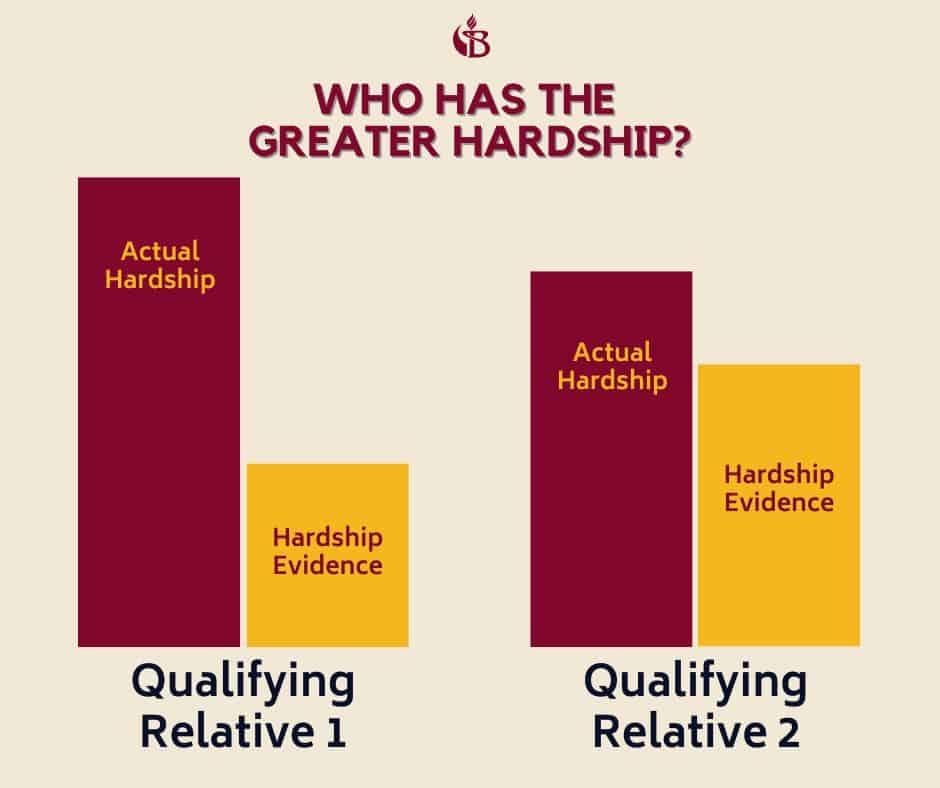
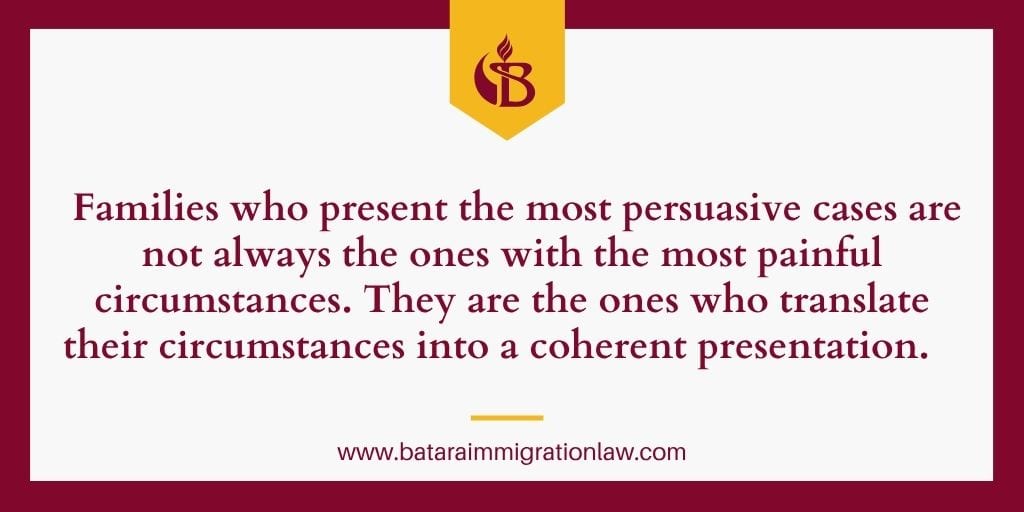
Families who present the most persuasive cases are not always the ones with the most painful circumstances. They are the ones who translate those circumstances into a coherent presentation officers can recognize as meeting the extreme hardship standard.
The Layers Beneath A Waiver Decision: How Officers Structure Their Hardship Analysis
Hardship in an I-601 or I-601A case is not evaluated as a single, unified question. Officers typically work through several distinct lines of inquiry. Weakness in any one of them can undermine the ultimate outcome.
The first question is relational: whether the persons most affected by the applicant’s absence are those recognized as qualifying relatives under immigration law. This is a threshold issue that, if mishandled, can undercut everything that follows.
The second concerns separation. If the qualifying relative remains in the United States while the applicant is abroad, what specific consequences would follow? Officers look for thorough proof of the effects on employment, healthcare, childcare, finances, mental health, and daily functioning — not general descriptions of emotional difficulty.
The third concerns relocation. Could the qualifying relative move abroad and preserve family unity? Officers evaluate this possibility with the same rigor as separation, examining country conditions, language barriers, medical access, safety concerns, employment prospects, and the disruption to children’s education or family support networks.
Underlying all of this is the evidentiary record. Every claim, however credible on its face, is assessed against what is documented. Medical records, financial statements, psychological evaluations, country condition reports, and personal declarations can strengthen – or weaken – all the waiver application, depending on how such matters are supported and explained.
Finally, officers must consider the totality of the circumstances. Hardship factors are not viewed in isolation. They are assessed as a whole, with each issue contributing to the overall picture of the family’s hardship.
But the overall picture of the family’s hardship is only as complete as the story behind it. Understanding why a qualifying relative will experience separation or relocation as severely as they will — and not merely that they will — requires something the standard evidentiary record rarely provides: the qualifying relative’s full backstory.
When Real Hardship Is Not Enough
The most important insight in hardship waiver practice may be this: cases often fail not because hardship is absent, but because the full story of the qualifying relative’s loss is inadequately communicated within the framework officers use to evaluate it.
Hardship described primarily in broad emotional terms – even when genuine – may not demonstrate consequences that rise beyond the ordinary disruption any separated family would face. Officers are trained to distinguish between hardship that is deeply felt but legally ordinary and hardship that is legally extreme.
Cases also fall short when they address separation but not relocation. Or when supporting documentation is present but not organized in a way that provides a coherent narrative. An unsubstianted claim, a vague declaration, or an inconsistency between hardship assertions and the submitted evidence can raise questions that an otherwise strong case never fully answers.
This disciplined approach has roots in my early academic training, a subject I discuss in How Harvard Law School Shaped My Approach To Immigration Law.
Coherence As A Legal Strategy: Why Presentation Is Substantive, Not Cosmetic
One of the less visible aspects of waiver cases is structure.
Officers reviewing hardship cases are often evaluating multiple intersecting issues at the same time: emotional impact, financial vulnerability, medical needs, country conditions, and family responsibilities. A case that treats such matters as separate, standalone problems can appear fragmented — even when each individual issue is compelling.
By contrast, a case that connects these elements into a coherent story — one that explains not only what will happen upon family separation, but also how the various consequences connect – is easier for officers to follow and more persuasive.
Structure in a hardship case is not a cosmetic concern. It reflects whether the applicant has genuinely understood how the I-601 or I-601A decision will be made and has organized the facts accordingly.
This is why I often describe effective waiver preparation as a form of structured storytelling: the disciplined work of connecting facts, evidence, and consequences into a coherent whole.
Where Stronger Cases Begin
Immigration hardship waiver cases are deeply personal matters decided within an impersonal system.
For the families who live through the waiver process, the disruption, fear, sacrifice, and uncertainty are real. For the officers who evaluate those cases, the same experiences are assessed through statutes, evidentiary standards, and legal frameworks that do not bend to the weight of feeling alone.
Families who recognize this distinction early are better positioned to prepare strong cases. Not because it makes the task easier — but because it changes how seriously and completely they approach it.
The strongest waiver cases are usually the ones where the family understood both worlds well enough to build a bridge between them.
After all, what separates stronger cases from weaker ones is rarely the depth of the hardship. It is whether the family grasped the distance between living it and proving it.
Review And UpdateThis page has been updated to reflect current immigration law and case strategy considerations.
Reviewed by Carlos Batara, Harvard Law School graduate and immigration attorney, with over 30 years of experience handling complex immigration cases.
Serving clients through our Hemet headquarters, throughout Riverside County and San Bernardino County, and nationwide through a virtual immigration law office.
Last updated: April 2026