Navigating the green card process is often a confusing journey, with unexpected twists and turns. When such moments occur, many immigrants feel confused, frustrated, and often afraid — afraid that their hopes of becoming a permanent resident are about to end.
For instance, nearly 30% of immigrants awaiting their green card interview dates instead receive a Request For Evidence (RFE). Many times, their fear is heightened by a belief they have no additional documents to provide.
Yet, as I have learned in my green card attorney practice, immigrants often underestimate the evidence they have access to. They also fail to understand the important differences between RFEs vs Notices Of Intent To Deny (NOIDs), and how those differences can affect the way USCIS evaluates their cases.
In many cases, the problem is not simply missing paperwork. The deeper issue is that immigrants misunderstand what immigration officers are scrutinizing when they issue Requests For Evidence.
USCIS is not merely asking for documents. Officers are often assessing credibility, consistency, and whether the facts of a case genuinely support eligibility for permanent residence. They are trying to determine whether the evidence reflects a real-life situation that satisfies immigration requirements.
In fact, an RFE is not the end of the road. It is an opportunity to strengthen your case and move closer to securing your green card.
Here is a three-step process that can help you put your best foot forward and help you better grasp what USCIS is looking for when reviewing your evidence.
Step 1: Understand What USCIS Is Really Asking
Many immigrants focus only on the specific documents listed in the notice. However, RFEs often involve broader concerns than applicants initially realize.
In some cases, USCIS is simply seeking omitted documents. In other situations, the agency may be questioning whether the evidence submitted actually proves eligibility for permanent residence.
This distinction matters.
Before gathering documents, begin by carefully reviewing the government’s request in detail. Identify the issue USCIS is trying to clarify or verify. Sometimes, the concern involves missing paperwork. Other times, officers may be evaluating credibility, consistency, legal eligibility, or whether the evidence reflects the reality of the relationship or immigration history being presented.
Once you have studied the RFE, carefully assess the evidence USCIS is requesting. You may not have exactly what USCIS mentions in the notice. However, you are not limited to the examples listed in the request. If you have other types of information that address the underlying concerns, it is appropriate to submit such evidence.
This is where many immigrants make mistakes. They search only for the exact documents named in the RFE and overlook other evidence that may help USCIS better understand the full picture of their case.
Mark your calendar with the deadline. Typically, green card applicants are given 30 to 87 days to respond. To avoid last-minute problems, try to reply as soon as possible. Do not, do not, do not miss the deadline.
Step 2: Identify The Evidence Many Applicants Overlook
Many immigrants mistakenly believe they have no additional evidence because they are thinking only in terms of formal paperwork.
Immigration officers often evaluate cases based on the totality of the circumstances. This means officers are looking at how the evidence fits together to help explain a person’s real-life situation.
It behooves every applicant for immigration benefits to actively search for the widest range of relevant proof as possible. Information that might seem unimportant at first glance may be the differentiation between being a case being approved or not.
In general, there are three common reasons that cause immigration authorities to seek additional information from green card applicants.
Reason A: Insufficient Information
You may have failed to submit important documents supporting your application. For example, USCIS may request financial information, such as tax returns, to determine whether a sponsoring petitioner satisfies affidavit of support income requirements.
However, officers are often checking more than whether a document is missing. They may also be trying to figure out if the financial evidence presented reflects a stable and genuine household situation.
Reason B: Proof of Eligibility
Sometimes the evidence submitted does not adequately demonstrate eligibility for permanent residence.
For instance, the government may seek evidence concerning an immigrant’s date or manner of entry into the United States. Other times, USCIS may examine issues involving residence history or whether an immigrant who entered on a fiancé visa was properly married within the required 90-day period.
Underlying these requests is a larger question: does the evidence clearly establish that the applicant qualifies for the immigration benefit being requested?
Reason C: Legal Issues
Other times, the inquiry centers on a legal issue USCIS wants to study more closely.
These inquiries may involve questions concerning the validity of prior marriages that sparked suspicions of marriage fraud. Or the issue may involve a past criminal conviction officers want to evaluate to determine whether it affects eligibility for permanent residence or requires a waiver.
In these situations, USCIS is often examining credibility, consistency, and whether the overall facts of the case support approval.
Types Of Evidence Applicants Often Minimize Or Neglect
This is why immigrants should not limit themselves to gathering only for traditional paperwork evidence.
Many applicants overlook valuable information already available to them. The following types of evidence can sometimes help officers better understand the reality of a relationship or living situation:
- Statements from friends, relatives, neighbors, church members, or community organizations
- Photographs documenting shared activities and milestones
- Travel records reflecting time spent together
- School records involving children
- Insurance records naming a spouse or family member
- Employment records reflecting shared financial life
- Evidence of social activities and daily shared life
In many cases, the issue is not the absence of evidence. The issue is recognizing what evidence actually helps tell the story USCIS is trying to understand.
If you are uncertain which types of evidence best address the concerns raised in your RFE, consulting with an experienced immigration attorney can help you identify and organize the strongest possible response.
This page has been reviewed by Carlos Batara, Harvard Law School graduate and immigration attorney. He has represented immigrants and families for over 30 years in responding to RFEs and NOIDS, green card applications, appeals, and complex immigration matters.
Last updated: May 2026
Step 3: Present Your Evidence In A Way USCIS Can Clearly Understand
A strong response does more than submit documents. It helps USCIS understand how the evidence answers the concerns raised in the Request For Evidence.
Organization matters.
When evidence is scattered, inconsistent, or poorly explained, even strong cases can become more difficult for officers to evaluate properly.
The goal is to help USCIS quickly understand:
- What evidence is being submitted
- Why the evidence matters
- How the evidence addresses the concerns raised in the RFE
Key Principles For Structuring Your Response
As you prepare your response, keep the following practices in mind:
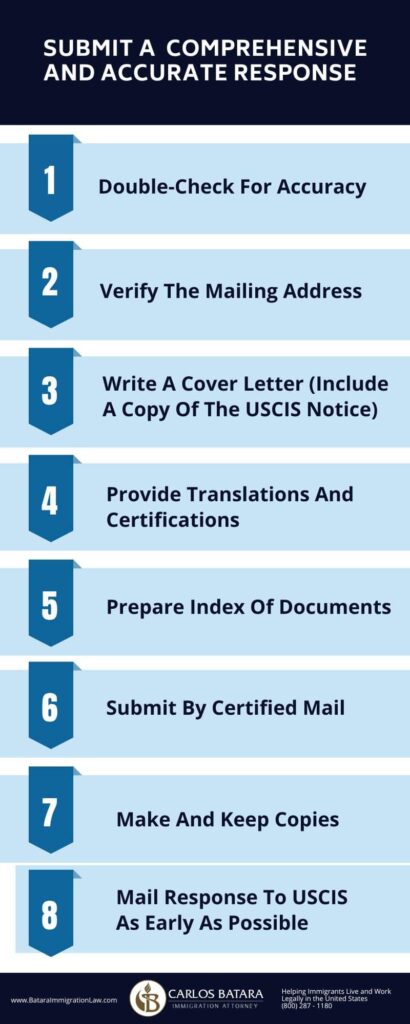
- Prepare a cover letter. Your cover letter should explain the evidence you are submitting and how it directly relates to the issues highlighted by USCIS. This is your opportunity to help officers connect the documents to the concerns raised in the RFE. Do not leave that connection for them to figure out on their own.
- Include a copy of the Request For Evidence notice. Attaching the Request For Evidence ensures officers can easily connect the response to its review of your case without having to locate the original notice separately.
- Review all documents carefully. Avoid inconsistencies or unnecessary confusion. Errors and contradictions within a submission can raise credibility concerns that did not exist before.
- Create an index of documents. An organized index helps officers review the materials efficiently and signals that your response is thorough and easy to follow.
- Group evidence by issue. Whenever possible, organize your documents around each specific concern raised in the RFE so the relevance of each piece of evidence is immediately clear to the reviewing officer.
- Include proper translations and certifications. Foreign-language documents must include accurate translations. Official documents should be accompanied by certified copies where required.
- Respond as early as possible. Submitting your response well before the deadline allows time to correct any problems that arise and eliminates unnecessary last-minute risk.
- Send your response via certified mail with a tracking number. Keep records showing when and how your response was sent to USCIS. Sometimes documents are misplaced or lost in the mail.
- Make a complete copy of your response package. Retain copies of all documents, evidence, translations, and correspondence submitted to USCIS.
A Note On What Officers Are Really Evaluating
Most importantly, remember that immigration officers are reviewing large volumes of cases. A response that is organized, clear, and easy to follow can help officers better understand the strengths of your case.
But presentation alone is not enough. As discussed throughout this guide, officers are also evaluating whether the evidence is credible, consistent, and reflective of a real-life situation that satisfies immigration requirements.
A well-organized response that clearly tells your story, supported by the right evidence, places you in the strongest possible position to address the government’s concerns.
RFE Guidance Throughout Hemet, San Bernardino County, And Riverside County
A Request For Evidence does not automatically mean your case is headed toward denial.In many situations, what you do next can directly affect the outcome. A carefully prepared response can strengthen your case and move it toward approval.
Depending on the circumstances, the right approach may include:
- Preparing a complete and well-organized RFE response
- Addressing the specific concerns raised in a NOID
- Supplementing your case with stronger supporting evidence
- Clarifying inconsistencies or legal issues identified by USCIS
The key is not just submitting documents—but presenting a response that directly answers the government’s concerns.
Careful legal guidance can help you identify the issues in your case, avoid common mistakes, and put forward the strongest possible response.
If you need assistance with an RFE or NOID, learn more about our regional offices and service hubs:
No matter where you live, we are committed to helping immigrants and families respond effectively to RFEs and NOIDs, strengthen their cases, and protect their future in the United States.
Nationwide Representation: Many clients also choose to work with our office remotely through our Virtual Immigration Law Office, enabling individuals and families across California and the United States to receive experienced immigration representation without needing to travel for in-person meetings.
Conclusion
A Request For Evidence is not simply a request for paperwork.
In many cases, when USCIS issues an RFE, the agency is reviewing whether the evidence presented is credible, consistent, and reflective of a real-life situation that satisfies immigration requirements.
Understanding those concerns, and responding in a clear and organized manner, can bring you one step closer to achieving your immigration goals.
Looking for assistance with responding to a Request For Evidence? Schedule a personalized strategy and planning session today.
Here's How It Works
1
Call Our Office
Immigration law doesn’t have to be confusing. You don’t have to live in fear of being deported and separated from your family. A comprehensive 30-minute Strategy And Planning Session will take the stress out of not knowing your options first-hand.
2
Meet With Carlos
Every case is unique. We refuse to take cookie-cutter approaches to your case. After we discuss the ins and outs of your immigration and family situation, Carlos will outline your chances for success and how to overcome obstacles standing in your way.
3
No Pressure - No False
Promises
Hiring a lawyer is a big investment, and we will not pressure you to hire us or push you into a plan you don’t understand. If we cannot help you, we will tell you. We will not take your case, unless we believe we can make a difference for you and your family.