What is hardship in immigration law – and why is it important?
It’s about your family’s suffering. Simply stated, how much they will suffer if you are removed from their lives.
Hardship is an important requirement in many immigration cases. In such cases, the amount of hardship your family will endure, upon your absence, makes the difference between winning and losing.
Although the term sounds simple to understand, it is anything but simple to prove.
In particular, proving the requisite hardship is often essential to overcome deportation charges at immigration court. It is also crucial in permanent residency cases involving consular processing and I-601 waivers.
Complicating matters even further, immigration law sets forth varying standards of hardship, which immigrants must demonstrate or they lose their case.
Extreme Hardship
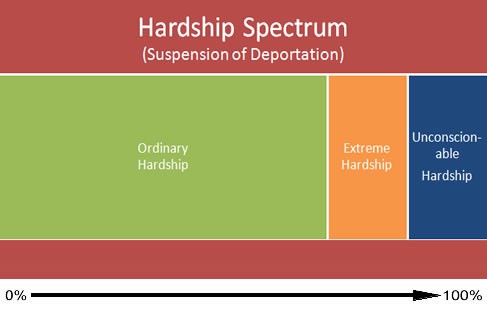
Extreme hardship is the original version of hardship. As shown in the graph above, it remains the clearest explanation of hardship.
Originally used primarily in immigration court matters, for the now defunct Suspension of Deportation remedy, extreme hardship analysis divided one’s severity of suffering into three levels: ordinary, extreme, and unconscionable.
However, this is not the only definition of hardship used in immigration law cases.
It is important to note that, on the one hand, the types of evidence needed to show the hardship in cases are relatively the same from case-to-case.
Yet, on the other hand, the degree of hardship – i.e., the degree of suffering – that must be backed by evidence differs from one form of hardship to another.
Puzzled?
You’re not alone.
The graphs below attempt to show the differences in a visual manner.
Exceptional And Extremely Unusual Hardship (BIA Version)
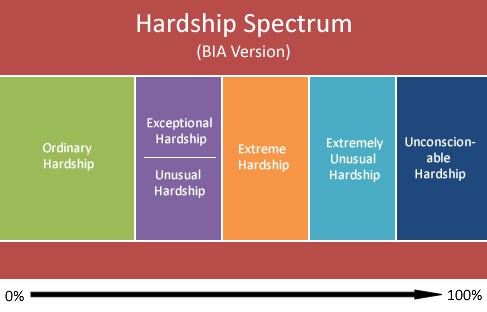
Cancellation of Removal replaced Suspension of Deportation in immigration court cases on April 1, 1997. As part of the descent into an age of immigration darkness, the requirement for hardship was changed to “exceptional and extremely unusual” hardship.
The graph above illustrates this change.
The legislative modification mandated a new judicial perspective towards the degree of suffering necessary for immigrants to prevail at their deportation hearings.
Congress’ intent was to make the hardship requirement, already rigid, into an even tougher qualification for immigrants to prove.
Exceptional And Extremely Unusual Hardship (Plain Language Version)
In my personal view on the new exceptional and extremely unusual standard set forth for hardship, the language used by Congress fell short of its its mark.
Rather, a plain language spectrum of hardship should look like the graph immediately below.
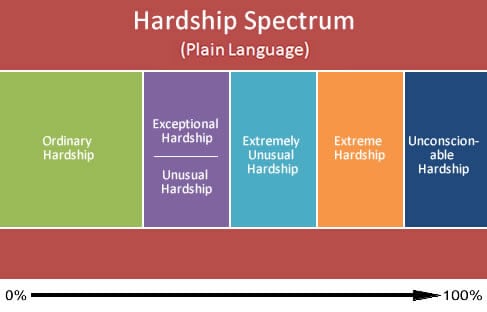
In short, I believe Congress erred. The language used in Cancellation of Removal matters lowered the standard of evidence in immigration court cases.
Nonetheless, immigration courts adhere to the BIA verion.
I-601 Waiver Hardship
On the other hand, the definition of hardship used by immigration agencies went relatively unchanged from the incorporation of the hardship standard in permanent residency and green card cases.
Until 2016.
At that time, the U.S. Citizenship and Immigration Services (USCIS) announced that it was revising how hardship should be analyzed in I-601 Waiver cases.
Based on the changes outlined in its operating manual, the current I-601 Hardship Waiver spectrum of severity follows the pattern shown below.
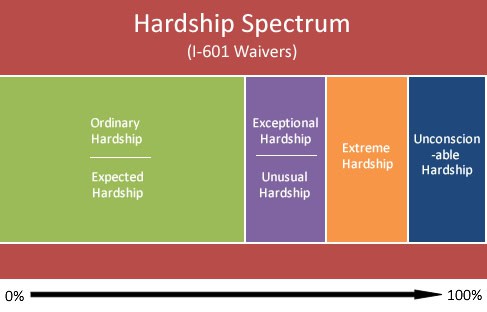
In the USCIS version of hardship, proving the existence of “extreme hardship” remains the standard necessary to win.
Other descriptions of hardships – “expected hardship”, “exceptional hardship” and “unusual hardship” – were added to show varying levels of suffering..
Such phraseology represents degrees of hardship lower than extreme hardship, and, hence, not strong enough to merit an I-601 waiver.
Recommended Reading:
By Carlos Batara
Last reviewed March 2026
Immigration law often turns on small factual distinctions and documentation details. If you would like to examine the strengths, weaknesses, and strategic options in your situation, you may want to schedule a confidential strategy and discussion session.